EV Charger Installation in Jacksonville
The circuit, the wiring and the mounting for a home charger, in the garage or out by the driveway.
Many electric cars come with a cord that plugs into an ordinary outlet, and it works, slowly. Once the car becomes the daily driver, the usual next step is a Level 2 charger on a 240 volt circuit that refills the battery overnight. Baymeadows Electric wires that circuit from your panel and mounts and connects the charger, whether it hangs on the garage wall or beside the driveway.
Charger Levels and What Each One Needs
Level 1 uses the 120 volts of a household outlet. Level 2 uses 240 volts, the supply a dryer or range runs on, and moves several times as much energy in an hour. Plugged in or wired straight in, a Level 2 charger gets a circuit of its own.
| Charger type | Typical use | What the home needs |
|---|---|---|
| Level 1 cord | Short daily drives and plug-in hybrids; the cord often comes with the car | An ordinary 120 V outlet near the car, GFCI-protected in a garage or outdoors |
| Level 2 plug-in | Daily commuting, with a unit that can move with you | A 240 V outlet, usually a NEMA 14-50 or 6-50, on a dedicated 40–50 A circuit |
| Level 2 hardwired | The same daily charging at up to 48 A, with nothing to unplug; common outdoors | A 240 V dedicated circuit wired into the unit, the breaker at 125 percent of its draw (60 A for a 48 A charger) |
That 125 percent is the code’s rule for continuous loads: a charger pulls its full current for hours, so the breaker and the wire get headroom. It is why a 40 amp charger sits on a 50 amp breaker.
How a Charger Circuit Goes In
The work usually follows this order:
- A load calculation: what the house already draws, from the air conditioning to the water heater, weighed against the size of the service.
- A look inside the panel for open breaker spaces and its overall condition.
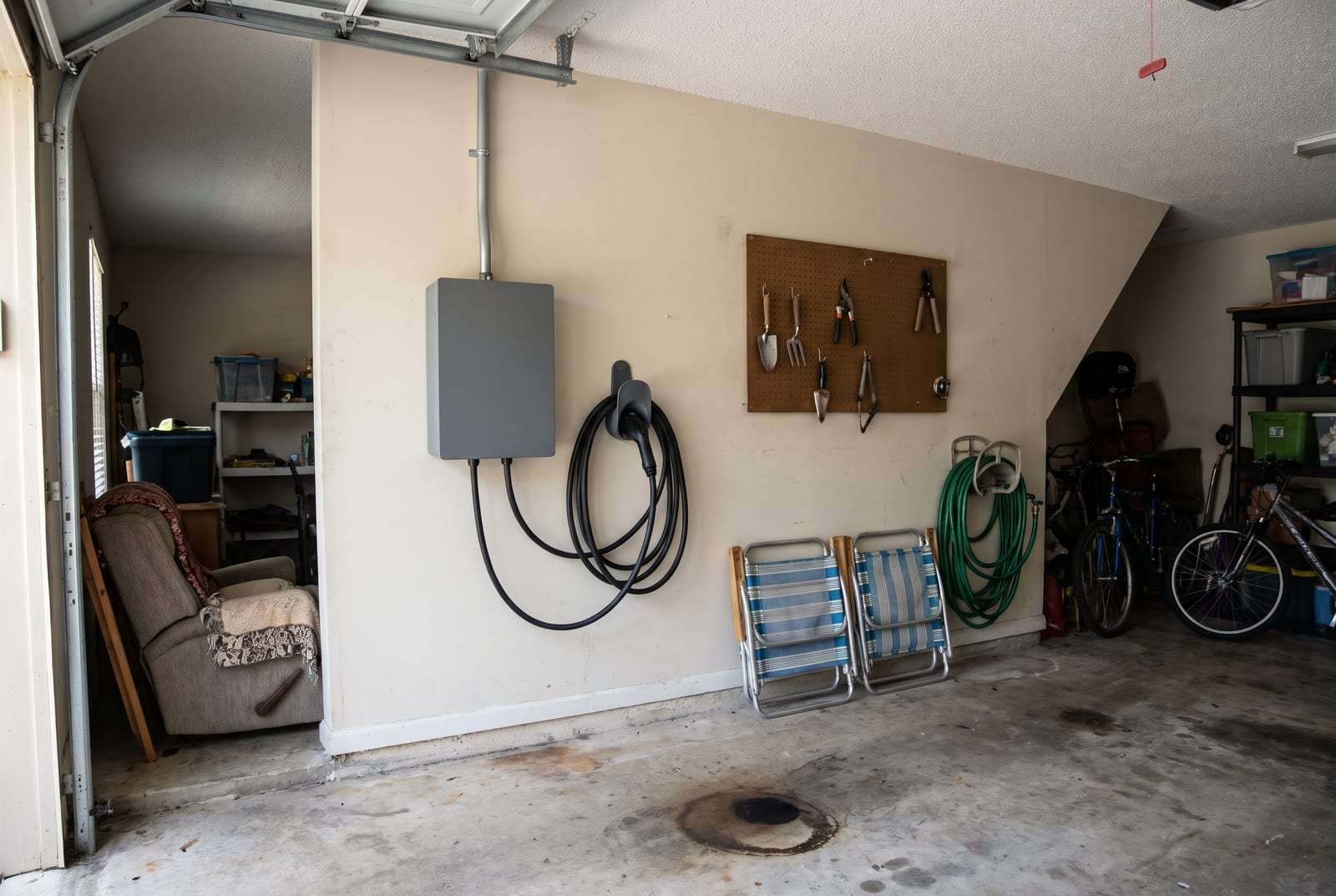
- Choosing the route to the parking spot: through the attic, along the garage wall in conduit, or outside to the driveway.
- Running wire sized for the breaker, then installing the breaker and either the 240 volt outlet or the charger itself.
- Setting the charger’s current to match the circuit, where the unit allows it, and testing with the car plugged in.
- An inspection where the local rules call for one.
A distant panel or a driveway mount makes the route longer, and an undersized panel may need a panel upgrade first.
Details That Shape the Install
A few facts about the car and the house settle most of the decisions:
- The car’s onboard charging rate, from the owner’s manual: it caps what any charger can deliver to that car.
- Your service size, which is the number on the main breaker, and whether the panel has open spaces.
- Where the car parks, and how far that spot is from the panel.
- Whether the charger will hang indoors or outdoors.
- A Wi-Fi signal at the spot, if you want app scheduling.
- Your HOA’s rules, if the unit will be mounted outside.
- For a rental home, the landlord’s permission in writing.
Still choosing the charger itself? Start with how plug-in, hardwired, indoor and outdoor chargers compare; the circuit follows from that choice.
Questions About Home Charging Circuits
Is my panel big enough for a Level 2 charger?
Will a home charger fit my car’s plug?
Can a charger be mounted outside in the rain?
Can I have a charger installed at a rental home or a condo?
What does load management do for an EV charger?
Summer Heat, Storms and Salt Air
Many 1980s to 2000s houses in Mandarin, Southside and Baymeadows have just the garage a charger needs, and a builder-grade panel now 25 to 40 years old. The load calculation decides whether that panel takes a 50 or 60 amp circuit as it stands, or whether a lower charger setting fits better.
A closed garage gets hot in a Jacksonville summer, and some chargers slow down when they overheat, so a shaded inside wall away from the water heater suits them. Outside, the afternoon thunderstorms of summer call for an outdoor-rated unit with its cable kept on the holster. Near Jacksonville Beach, salt air works on outdoor connections, which makes a garage wall or a covered spot worth the extra wire.
In hurricane season, a charger that took on water stays off at the breaker until it has been checked.
Spring is the time to check panels and outdoor outlets Summer storms are hard on surge protection and GFCIs After hurricane season, look over outdoor wiring Winter brings space heaters onto older circuits